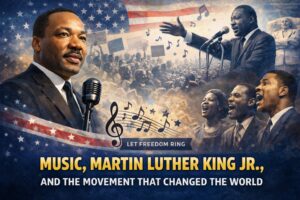
Dr. Martin Luther King Jr. is remembered as one of the most influential leaders in history—not simply because of what he believed, but because of how he moved people. His legacy reaches far beyond laws and legislation. It lives in hearts, in culture, and in the shared human desire for dignity, justice, and freedom.
One of the most powerful forces that helped carry his message was music.
Music as a Universal Language
Music has always had a unique ability to reach people where words alone cannot. It crosses racial, cultural, political, and generational lines. Dr. King understood this deeply. His mission was never about helping some people—it was about uplifting all people. Music operates the same way. It doesn’t ask where you’re from before it moves you. It doesn’t require agreement before it creates connection.
Like Dr. King’s dream, music invites people into a shared experience—one that says, we are in this together.
The Soundtrack of the Civil Rights Movement
Music was not a background element of the Civil Rights Movement—it was a driving force. Freedom songs, spirituals, and hymns were sung in churches, on buses, during marches, and even in jail cells. Songs like “We Shall Overcome,” “Lift Every Voice and Sing,” and “This Little Light of Mine” gave people courage when fear was present and hope when circumstances felt impossible.
Dr. King often spoke about the role of spirituals and gospel music in sustaining the movement. These songs reminded people of their worth, their history, and their future. They unified crowds, strengthened resolve, and transformed protest into purpose.
Music didn’t just accompany the movement—it moved the movement.
Rhythm, Repetition, and the Power of Voice
There is a musical quality to Dr. King’s speeches themselves. His use of rhythm, repetition, and call-and-response echoes the traditions of Black church music and African American spirituals. Phrases like “I have a dream” and “Let freedom ring” weren’t just spoken—they were felt.
In many ways, Dr. King preached justice the way music performs truth: with timing, emotion, and intention. His voice rose and fell like a melody, making his message unforgettable and deeply human.
Music and the Ongoing Work
Dr. King believed in progress through love, nonviolence, and collective action. Music continues to play that same role today—giving voice to the voiceless, challenging injustice, and inspiring people to imagine something better.
From gospel to jazz, soul to hip-hop, protest songs to praise songs, music remains a vehicle for truth and transformation. It reminds us that movements are sustained not only by strategy, but by spirit.
A Shared Responsibility
Dr. King’s legacy calls each generation to ask: What will we do with the dream? Music asks a similar question: What will we do with the sound we’ve been given?
When music is used with purpose, it can heal, unite, and awaken conscience—just as Dr. King did. Both remind us that real change begins when people are willing to listen, feel, and act for the good of all.
As we honor Dr. Martin Luther King Jr., we also honor the music that marched alongside him—and we recommit ourselves to using our voices, talents, and influence to move the world closer to justice, unity, and hope.
Terrence – The Music Master