
·
Nobody Signed Up to Play Scales. They Signed Up to Play the Song.
Every teacher at Tupelo Music Academy has heard some version of it.
“Can we just play the song?”
“Do I have to do this part again?”
“I already know how it goes — I heard it on Spotify a hundred times.”
Here’s the truth: that impatience isn’t a discipline problem. It’s a sign of life. It means a kid has a song in their heart before they have the skill in their hands. Our job isn’t to talk them out of wanting that. Our job is to close the gap between the two as fast and as fun as we possibly can.
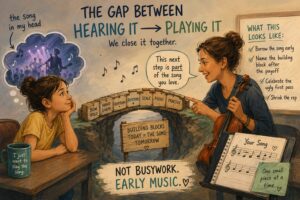
The Gap Between Hearing It and Playing It
Every song a student loves was built out of small, unglamorous pieces — a bow hold, a hand shape, a rhythm pattern, a scale that sounds like nothing on its own. Building blocks don’t feel like music yet, and to a seven-year-old (or a thirty-seven-year-old beginner), that’s frustrating. They can hear the finish line. They just can’t stand the walk to get there.
That’s where great teaching earns its keep — not by lecturing a student into patience, but by making the walk itself feel like part of the song.
We asked our violin instructor, Ms. Lockhart, how she handles this in her own studio, since violin is one of the least forgiving instruments when it comes to fundamentals. Here’s what she said:
“I never tell a student ‘we have to do this first.’ I tell them ‘this next.’ The bow hold isn’t a hurdle before the song — it’s the first four notes of it. If I can make the boring part sound even a little bit like the song they’re chasing, they stop fighting me and start chasing it with me.”
— Ms. Lockhart, Violin Instructor, Tupelo Music Academy
That’s the whole philosophy in one paragraph. Not “eat your vegetables before dessert.” More like — the vegetables are dessert, we just haven’t plated them right yet.
What This Looks Like in Practice
A few ways our instructors close the gap between “I want to play the song” and “I can play the song”:
Borrow the song early. Even a single phrase, played badly but recognizably, on day one. Recognition is motivation.
Name the building block after the payoff. Not “finger pattern drill #3” — “the part that makes the chorus sound right.”
Celebrate the ugly first pass. The first time a student stumbles through a real song, even rough, is a bigger win than a clean scale. Let them feel that.
Shrink the rep. One measure at performance tempo beats sixteen measures at a crawl. Kids feel progress in seconds, not weeks.
The Bigger Point
Kids don’t want to “learn an instrument.” They want to play music — theirs, right now, the song stuck in their head on the car ride to lessons. Building blocks that don’t visibly connect to that song feel like busywork. Building blocks that clearly are that song, just early, feel like progress.
That’s the difference between a student who quits at week six and a student who’s still here at year six.
If you’ve got a student pushing back on the fundamentals right now, take it as a good sign. It means they already love the song. Our job is just to catch up to that love, one small piece at a time.
— From the M-Tribe Music Magazine, Tupelo Music Academy